
2026 Best Geomembrane Liner Types for Global Buyers
Choosing the right Geomembrane Liner in 2026 requires more than comparing prices or advertised thickness. Global buyers face different soil conditions, ultraviolet exposure, temperatures, chemicals, installation skills, and regulatory expectations. A liner that performs well beneath a European landfill may behave differently beside a tropical aquaculture pond.
Recent market research from Grand View Research and MarketsandMarkets indicates continued growth in geomembranes and the wider geosynthetics sector. Their findings connect demand with landfill expansion, mining containment, water conservation, wastewater treatment, and infrastructure development. However, these reports use different market boundaries and forecasting methods. Direct comparisons can mislead buyers.
Look closer.
Technical selection should follow project evidence. High-density polyethylene often offers strong chemical resistance and long service potential. Linear low-density polyethylene can provide greater flexibility on irregular subgrades. Polyvinyl chloride may suit certain fabricated systems, but plasticizer performance requires careful review. Product data should be checked against recognized testing methods, including ASTM D5199 for thickness, ASTM D4833 for puncture resistance, and ASTM D5885 for stress-crack resistance where relevant.
The International Geosynthetics Society and the Geosynthetic Institute also emphasize material testing, seam quality, installation control, and site-specific design. These details matter when a textured surface meets a steep slope, or when a welding crew works beneath afternoon heat.
No material is universally best.
This guide compares leading Geomembrane Liner types for global buyers in 2026. It considers performance, application fit, durability, welding behavior, environmental exposure, and total project risk. Some conclusions remain conditional. That is intentional. Supplier claims still require independent verification, field experience, and thoughtful engineering review.
What Is a Geomembrane Liner and Why Does It Matter?
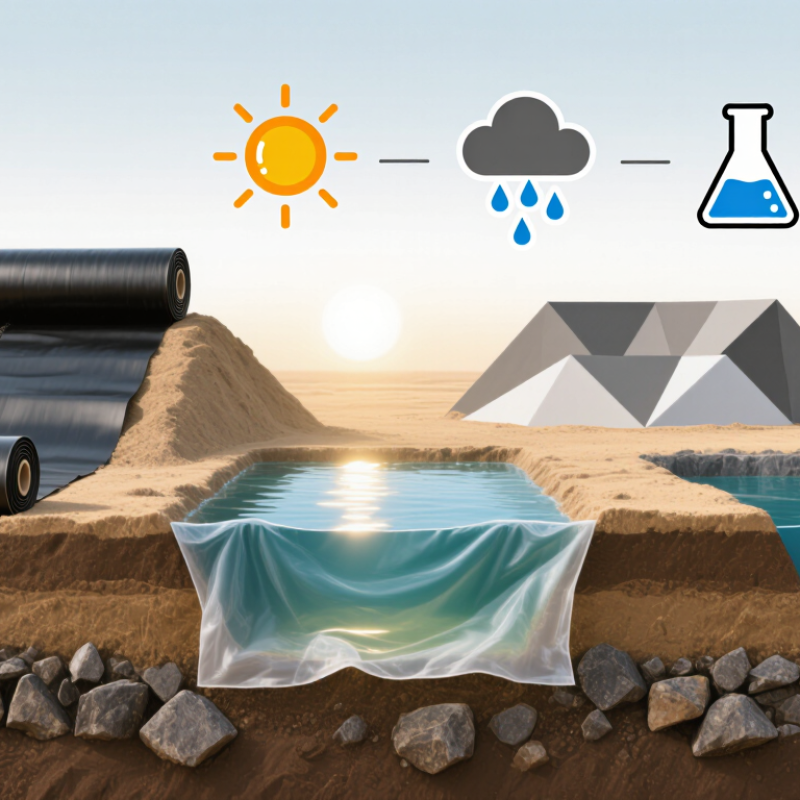
A geomembrane liner is a manufactured, low-permeability sheet used to control liquid or gas movement through soil. Common materials include HDPE, LLDPE, PVC, and EPDM. Each type behaves differently under temperature, stress, chemicals, and installation conditions. The liner is not simply a waterproof blanket. It is part of an engineered containment system.
Its value becomes clear at a construction site. A properly selected liner can protect soil and groundwater from stored water, wastewater, or process liquids. It can also reduce seepage from ponds, reservoirs, and irrigation canals. Material thickness matters. So does surface preparation. Sharp stones, trapped air, weak seams, and uneven subgrade can create failures that are invisible at first. Small defects matter.
Global buyers should request test data for tensile strength, puncture resistance, elongation, chemical compatibility, and weathering performance. They should also examine seam testing procedures and installation experience. Climate deserves careful attention. A liner exposed to intense sunlight may need stronger resistance to oxidation and ultraviolet damage. Cold regions create different risks. A flexible material may perform better during movement, but no selection is automatically correct. Field inspection, documented quality control, and trained welding technicians remain essential. Even a strong specification can fail when installation is rushed. That is easy to underestimate.
2026 Best Geomembrane Liner Types for Global Buyers – What Is a Geomembrane Liner and Why Does It Matter?
A geomembrane liner is a manufactured, low-permeability membrane used to control the movement of liquids, gases, or contaminants in engineered containment systems.
| Geomembrane Type | Typical Thickness | Typical Tensile Strength | Typical Elongation at Break | Key Performance Characteristics | Common Applications | Best For Global Buyers Seeking |
|---|---|---|---|---|---|---|
| HDPE (High-Density Polyethylene) | 0.75–3.00 mm (30–120 mil) | Typically 15–30 MPa, depending on thickness and test direction | Typically 600–900% | Excellent chemical resistance, low permeability, strong UV resistance, and high puncture resistance. Heat-welded seams provide reliable long-term containment. | Mining leach pads, landfill caps and liners, wastewater lagoons, industrial ponds, aquaculture ponds, and secondary containment. | Long service life, demanding chemical exposure, and large engineered containment projects. |
| LLDPE (Linear Low-Density Polyethylene) | 0.75–2.50 mm (30–100 mil) | Typically 12–25 MPa, depending on formulation and thickness | Typically 700–1,000% | More flexible and conformable than HDPE, with high elongation and good resistance to stress cracking. Suitable for irregular subgrades and settlement-prone areas. | Agricultural reservoirs, irrigation canals, landfill systems, pond liners, biogas facilities, and irregularly shaped containment areas. | Flexibility, easy installation around curves, and tolerance of differential settlement. |
| PVC (Polyvinyl Chloride) | 0.50–2.00 mm (20–80 mil) | Typically 10–25 MPa, depending on formulation | Typically 200–450% | Flexible, lightweight, and easy to fabricate. It generally offers good resistance to many salts, acids, and alkalis, but compatibility must be checked for hydrocarbons and aggressive chemicals. | Decorative and irrigation ponds, canals, water features, temporary containment, and selected wastewater applications. | Fast handling, flexible installation, and projects with moderate service demands. |
| fPP (Flexible Polypropylene) | 0.75–2.00 mm (30–80 mil) | Typically 12–25 MPa, depending on construction | Typically 400–700% | Flexible over a broad temperature range, resistant to many chemicals, and suitable for prefabricated panels. It can be thermally welded when compatible grades and equipment are used. | Potable-water reservoirs, industrial tanks, aquaculture systems, secondary containment, and complex fabricated liners. | Prefabrication, flexibility, and clean-water or industrial containment systems. |
| EPDM (Ethylene Propylene Diene Monomer) | 0.75–2.00 mm (30–80 mil) | Typically 7–17 MPa, depending on grade | Typically 300–600% | Highly elastic, with strong resistance to weathering, ozone, and ultraviolet exposure. It is not the preferred choice for many hydrocarbon-based liquids. | Decorative ponds, water gardens, reservoirs, irrigation ponds, and applications requiring substantial movement accommodation. | Outdoor flexibility, weather resistance, and applications with significant substrate movement. |
| CSPE (Chlorosulfonated Polyethylene) | 0.75–1.50 mm (30–60 mil) | Typically 14–21 MPa, depending on grade | Typically 300–500% | Good resistance to weathering, ozone, oxidation, and a broad range of chemicals. Availability and project-specific fabrication requirements should be confirmed in advance. | Industrial wastewater, chemical containment, water-treatment facilities, and specialized environmental protection systems. | Specialized chemical resistance and proven performance in demanding outdoor environments. |
| Reinforced PVC | 0.75–1.50 mm (30–60 mil) | Typically 15–30 MPa, depending on reinforcement and coating | Typically 20–80% in the reinforced direction | Reinforcement improves dimensional stability and handling strength. It is often supplied as prefabricated panels, reducing field seaming requirements. | Tank linings, wastewater treatment, secondary containment, temporary storage, and fabricated industrial covers. | Dimensional stability, prefabricated installation, and controlled fabrication environments. |
Technical note: The values shown are typical industry ranges for comparison only. Actual properties vary according to resin formulation, reinforcement, thickness, test method, temperature, and applicable standards such as ASTM, ISO, GRI, or EN. Final material selection should consider chemical compatibility, design life, subgrade conditions, seam performance, climate, installation method, and regulatory requirements.