Choosing the best power tools made in China takes more than reading a country label. China is a major manufacturing base, but products vary widely in motor quality, battery design, safety features, and after-sales support. Grand View Research estimated the global power tools market at about $32.3 billion in 2023, with continued growth forecast through 2030. That scale makes careful comparison worthwhile. A large market offers choice, not a guarantee of quality.
Tool-testing editor Roy Berendsohn of Popular Mechanics is a useful reference point for practical evaluation. His reviews emphasize how tools perform in real work, beyond their specifications. A fitting buying rule is: “Judge the tool by the work it repeats, not the claims on its box.” For buyers, that means checking how steadily a drill drives screws, whether a saw cuts cleanly, and how a battery feels after a full work session. Small details matter.
This guide compares Chinese-made power tools by intended use, performance, durability, battery compatibility, warranty, and parts availability. It also distinguishes brands that manufacture in China from brands headquartered there; those are not the same thing. A low price may be appealing, but replacement batteries and service can change the real cost. Even the strongest specifications cannot show how a tool will hold up in a dusty workshop. The rankings should therefore be treated as a practical shortlist, not a promise that every unit will perform identically.
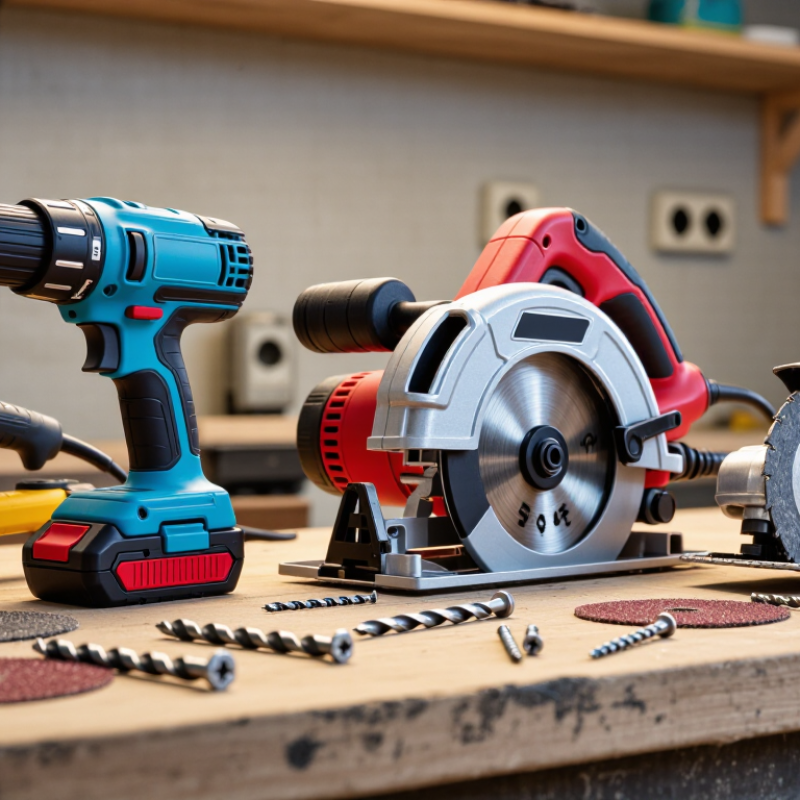
“Made in China” can describe where a product’s substantial manufacturing or final assembly takes place. It does not necessarily mean every component was made there. For power tools, the distinction matters: a drill may combine locally molded housing and assembled electronics with imported battery cells or specialized components. Origin-label rules also vary by destination market, so the phrase alone does not reveal the full sourcing story. That distinction matters.
The supply chain can begin with steel, copper, plastics, and battery materials, then move through motor production, circuit-board assembly, housing molding, tool assembly, testing, and packaging. Some factories handle several stages; others rely on nearby specialist suppliers. China’s General Administration of Customs reported 13.92 trillion yuan in mechanical and electrical product exports in 2023, or 58.6% of the country’s total exports. This broad category includes far more than power tools, so it shows manufacturing scale, not tool-specific output. A useful factory check is to ask where the motor, battery pack, and control board are made, and where final testing occurs. The boundary can be messy. Labels rarely tell the whole story.
The best power tools made in China are not identified by a country label alone. Compare verified product ranges, export evidence, and service support before judging quality. A catalog should show specific tool categories, model numbers, voltage options, and published specifications. Check whether those details match product manuals and current listings. A broad range looks impressive, but it may hide gaps in a buyer’s actual needs.
Export data can help confirm a manufacturer’s trading activity, but it cannot prove tool performance. Review credible shipment records, dates, and product descriptions where available. Compare several periods rather than relying on one large shipment. Look closer. Export records may group products broadly, so treat them as evidence of activity, not a quality rating. A spreadsheet can still mislead.
Service is easier to assess through practical questions. Are replacement brushes, batteries, and guards available for the models being considered? Is the warranty written clearly, and can support explain the repair process? Ask for response times and spare-parts lead times in writing. Then test support with a real product question. Small checks matter. My comparison would remain provisional until sample tools are tested under the same workload; paper specifications do not reveal every weakness.
Brand and company names are omitted. Export statistics are reported by product classification, not by brand; service coverage must be checked for the specific seller and destination market.
| Tool category | Product range to compare | Common power or platform classes | Export-data reference | Service checks for buyers |
|---|---|---|---|---|
| Drills and drivers | Drill drivers, hammer drills, and impact drivers; compare chuck type, torque settings, speed range, and included batteries. | Cordless platforms commonly include 12 V and 18 V nominal systems; some 18 V systems are marketed as 20 V max. | Cordless electric hand tools generally fall within HS heading 8467; customs reporting detail varies by country and tool type. | Confirm battery availability, charger plug and voltage, replacement chuck supply, warranty terms, and local repair arrangements. |
| Angle grinders | Compare disc diameter, spindle thread, speed, guard design, and whether the range includes corded and cordless models. | Corded models are rated by input power; cordless versions are specified by battery platform and disc size. | Usually included in HS 8467 electric hand-tool trade classifications; published totals do not identify individual manufacturers or brands. | Check guard and side-handle availability, compatible discs, spindle parts, and access to authorized service in the destination country. |
| Circular saws and jigsaws | Compare blade diameter or stroke length, cutting depth, bevel range, dust extraction, and corded versus cordless options. | Cordless models use platform-specific batteries; corded models must match the destination market’s mains voltage and frequency. | Electric hand-held saws are covered by the broader HS 8467 family; use the importing country’s tariff schedule for the applicable subheading. | Verify blade or blade-clamp compatibility, replacement base components, spare-part lead times, and the local warranty process. |
| Rotary hammers | Compare chuck system, impact energy, drilling capacity, operating modes, and dust-control accessories. | Corded and cordless versions are available in the market; specifications and compatible accessories are model-specific. | Trade data may be grouped with other electric hand tools under HS 8467, limiting direct comparison between individual tool types. | Ask about chuck and seal parts, service-center locations, repair turnaround, and warranty coverage for heavy-duty use. |
| Impact wrenches | Compare drive size, fastening and breakaway torque claims, speed settings, and intended automotive or construction use. | Cordless models are commonly tied to a battery platform; pneumatic models are classified separately from electric hand tools. | Electric versions may be captured in HS 8467 electric-tool classifications; pneumatic versions can fall under a different subheading. | Check socket-retention parts, battery and charger supply, torque-test documentation, and the seller’s written warranty conditions. |
| Sanders and polishers | Compare orbital or rotary action, pad size, speed control, dust collection, and availability of replacement pads. | Corded and cordless products exist; the relevant electrical rating and consumable fit depend on the model and destination market. | These products may be reported within HS 8467; use customs records at the most detailed available national tariff level. | Confirm pad and dust-bag supply, replacement switch and motor parts, service contacts, and whether warranty claims can be made locally. |
A strong power tool is not judged by its country of manufacture alone. Check whether its safety documentation refers to IEC 62841-1, the general safety standard for hand-held and transportable motor-operated tools. Then look for the applicable IEC 62841-2 standard, which adds requirements for a specific tool type. A drill and a grinder face different hazards. One standard cannot cover every detail.
Read the rating plate and instructions, and compare the stated tool category with the cited standard and edition. Check practical safeguards too: a secure guard, a switch that releases cleanly, and clear guidance on dust, vibration, and accessory limits. That matters. A test report or certification from a competent independent body can strengthen confidence, but a reference to IEC alone does not prove every model was tested or certified. Ask for model-specific evidence, not a general company claim. Standards are useful, but they do not replace a careful inspection: a cracked housing or loose guard deserves attention, even when the paperwork looks tidy. I would also pause if the manual is vague. That is not proof of a defect, but it is a reason to ask more questions.
IEC 62841-1 sets general safety requirements; the applicable tool-specific Part 2 adds requirements for particular tool types. This chart maps selected tool categories to their relevant standards—it does not rate products or confirm compliance.
How to read: Each bar represents one applicable standards layer: the general requirements in IEC 62841-1 and the tool-specific requirements listed for that category. Verify the current edition and applicable requirements for the exact tool before assessing safety.
When comparing power tools made in China, read the battery specifications beyond the large voltage number. Many lithium-ion tool packs use five cells in series: about 18 volts nominal and close to 20 volts when fully charged. A “20V Max” label often describes peak voltage, while “18V” describes nominal voltage. That difference alone does not prove one platform runs longer or delivers more useful power. Labels can mislead.
Check watt-hours (Wh) to compare stored energy more consistently. A 18V, 2Ah pack contains about 36Wh, using nominal voltage multiplied by amp-hours. If a package gives only 20V and 2Ah, its 40Wh figure may use peak voltage instead. Look for the manufacturer’s stated watt-hours, and compare figures calculated on the same basis. More watt-hours can mean longer runtime, but not an exact number of cuts or screw turns. Material, tool load, temperature, and battery age all matter.
Also check which tools accept the same battery platform. A compact 2Ah pack may feel lighter on a drill, while a larger pack can help with sustained, demanding work. It may add noticeable weight overhead. Watt-hours measure energy, not motor strength or build quality. I still think these labels could be clearer; comparing them takes a little patience.
When comparing power tools made in China, match the specification to the material and task—not just the highest number on the box. For drilling hardwood or driving large fasteners, check torque in newton-metres and whether the tool offers a low-speed setting. A high RPM rating helps with smaller bits and clean, quick drilling, but it does not guarantee control under load. For cutting tools, compare maximum cutting depth with the thickness of your stock; a saw rated for 65 mm cannot safely replace one with greater capacity on thicker material. Check the test conditions, too. Peak figures can be less useful than sustained performance.
Power and speed are linked: mechanical power depends on torque and rotational speed, so stronger performance under load matters more than free-running RPM alone. The U.S. Department of Energy’s 2014 Improving Motor and Drive System Performance sourcebook estimates motor-driven systems account for about 69% of U.S. industrial electricity use.
That figure covers industrial systems, not handheld-tool efficiency, but it underscores why matching power to the job matters. For repeated cuts, compare cutting capacity and duty-cycle guidance, then consider battery runtime or corded power. A heavy tool may feel reassuring, yet fatigue can reduce accuracy. I may still give peak torque too much weight; actual results also depend on the bit, material, and operator.