7 Best Science Education Kits for Schools in 2026?
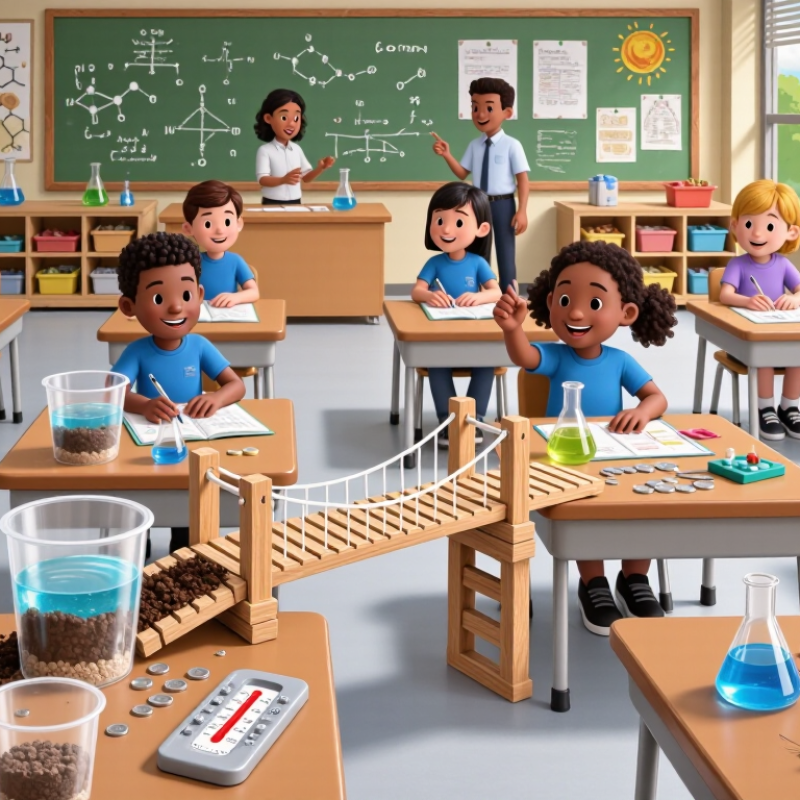
Choosing the right Science Education Kits in 2026 requires more than comparing colorful boxes and attractive price tags. Schools need tools that turn scientific ideas into visible, testable experiences. A strong kit should include durable materials, clear teacher guidance, age-appropriate challenges, and space for students to make mistakes. A small bridge that bends under pennies can teach load, balance, measurement, and revision more effectively than a long worksheet.
John Dewey, an influential education philosopher, wrote, “Education is not preparation for life; education is life itself.” His idea remains useful here. The best Science Education Kits connect classroom learning with real decisions. Students might observe soil settling in a transparent cup, record temperature changes, or redesign a paper circuit after it fails. These details matter because hands-on work creates evidence, not just impressions. Still, no kit is automatically effective. A poorly explained activity can become a craft project. A costly kit may also gather dust if teachers lack training or replacement parts.
This guide examines seven leading options for schools in 2026. It considers scientific accuracy, classroom safety, curriculum alignment, accessibility, reusability, and teacher workload. It also looks beyond marketing claims. Can thirty students share the materials? Are instructions understandable? Do experiments encourage questions rather than predictable answers? Some choices may appear imperfect. That is honest. The strongest kit depends on age, budget, lesson goals, and local classroom conditions.
Ranking Criteria: NGSS Fit, Safety, Cost, and OECD PISA’s 485-Point Mean
For 2026, I rank seven science education kits by four practical measures: NGSS fit, safety, total cost, and PISA relevance. NGSS alignment earns 35 percent because strong kits make students ask questions, model systems, and use evidence. The OECD PISA 2022 Results report places the OECD science mean at 485 points. The benchmark is clear. The best kits should build explanation skills, not only produce colorful reactions.
Safety receives 25 percent. I check age guidance, protective equipment, storage instructions, and teacher supervision. A safer design uses sealed materials, clear labels, and low-risk procedures. It also explains what happens when an experiment fails. Cost receives 20 percent, including replacement supplies, preparation time, and shipping. A low purchase price can mislead schools. UNESCO’s 2023 Global Education Monitoring Report highlights continuing infrastructure gaps, including limited electricity access in many schools. Therefore, kits should work with simple tools and minimal power.
The remaining 20 percent measures PISA-style thinking: interpreting data, evaluating claims, and connecting evidence to real problems. My ranking favors kits with reusable components and printable investigation sheets. I also reduce scores for activities with one predictable answer. That criterion is imperfect. Classroom results depend on teacher training, student language, and available time. A kit can be excellent on paper, yet frustrating at 8:30 a.m. in a crowded classroom. My strongest choices therefore combine standards-based investigations, visible safety routines, and a realistic per-student cost.
Best Biology and Chemistry Kits: Inquiry, Lab Skills, and Consumables
For 2026 school purchasing, biology and chemistry kits should build inquiry, not merely produce attractive results.
OECD’s PISA 2022 Results reported an average science score of 485 points, four points below 2018. This signals a need for stronger scientific reasoning. It does not prove that kits solve learning gaps. Practical design still matters.
Biology sets should support microscope work, cell observation, classification, and evidence-based explanations. Chemistry sets should include measured reagents, safe reaction vessels, indicators, and clear waste procedures. Students need to predict, test, record, and question unexpected results.
Keep consumables visible and manageable. A teacher should quickly check expiry dates, quantities, storage conditions, and replacement costs.
Small group formats work well: one learner measures, another records, and a third challenges the conclusion.
UNESCO’s 2023 Global Education Monitoring Report noted that 2.6 billion people remained offline in 2021.
Physical investigation therefore remains valuable, especially where digital access is uneven. Yet a kit without teacher preparation becomes a box of instructions. I have seen students follow steps perfectly while missing the scientific idea.
Better guides include open questions, sample data tables, safety reminders, and simple extension tasks.
The design will not be flawless. Schools should review student work after each unit and revise the kit before buying more.
Best Physics and Earth-Science Kits: Modeling, Measurement, and Field Data
The best school science kits in 2026 should make invisible ideas measurable. Physics kits need motion tracks, force sensors, circuits, and adjustable variables. Earth-science kits should include rock samples, soil columns, weather tools, and simple mapping equipment. Students learn more when they record a changing temperature outside, not only read a definition.
The OECD’s PISA 2022 report shows that science performance remains uneven across education systems. It also highlights the importance of applying knowledge to real-world problems. Measurement-based kits support that goal. A student can estimate friction, compare soil drainage, or model lunar phases with a light and sphere. These tasks build evidence-based reasoning. They also reveal uncertainty, which many classroom worksheets hide.
Good kits need clear calibration steps and safe, repeatable procedures. Teachers should check whether results can be collected in ten minutes or less. Small groups need visible roles: operator, recorder, checker, and interpreter. Field data can be messy. Sensors drift. Rocks may be misidentified. My own preference is not always the most efficient choice, either. A beautifully designed model can still produce weak learning if students never question its assumptions. UNESCO’s Global Education Monitoring reporting repeatedly connects practical learning with stronger engagement, but equipment alone cannot guarantee understanding. The strongest physics and Earth-science kits leave room for error, revision, and a second measurement.
Best Robotics and Coding Kits: Engineering Design and BLS’s 10.8% STEM Growth
Best Robotics and Coding Kits: Engineering Design and BLS’s 10.8% STEM Growth
Robotics and coding kits can turn a classroom desk into a small engineering laboratory. Students build a sensor system, test movement, and revise their code after failure. This process reflects authentic engineering design more closely than memorizing isolated commands. The U.S. Bureau of Labor Statistics projects 10.8% growth for STEM occupations from 2022 to 2032. Schools should therefore choose kits that develop practical problem-solving, collaboration, and computational thinking.
A strong kit should include reusable parts, clear teacher guidance, adjustable difficulty, and offline learning options. Students might program a vehicle to follow tape across the floor, then measure where it veers. Teachers can assess design decisions, testing notes, and explanations, not only the final result. I have found that simple challenges often produce deeper discussion. However, some kits promise too much. Complicated setup can consume valuable class time and discourage beginners.
Tips: Start with a 30-minute build challenge. Assign rotating roles, such as designer, coder, tester, and recorder. Keep spare cables and batteries nearby. Ask students to explain one failure before changing their design. Check accessibility carefully, especially for learners using alternative input devices. Pricing matters, but long-term repairability matters more.
7 Best Science Education Kit Focus Areas for Schools in 2026
These seven areas connect robotics, coding, and engineering-design projects with U.S. Bureau of Labor Statistics employment projections for 2022–2032. The figures show projected employment growth for related STEM occupations, not sales data for any company or product.
How to use this chart: Schools can prioritize hands-on kits that develop programming, data analysis, cybersecurity, automation, scientific modeling, and mechanical-design skills. The overall STEM occupation growth projection is 10.8%, compared with 2.8% for non-STEM occupations.
Source: U.S. Bureau of Labor Statistics, Employment Projections, 2022–2032. Selected occupation projections are used to illustrate curriculum priorities.
School Buying Matrix: Teacher Training, Accessibility, Scalability, and ROI
7 Best Science Education Kits for Schools in 2026?
A strong school buying matrix should score more than experiment variety. Teacher training comes first. The Education Endowment Foundation reports that effective professional development depends on active practice, feedback, and sustained support. A kit with clear lesson sequences, safety guidance, and short training videos can reduce setup time. However, one workshop is rarely enough. Test it live.
Accessibility must be visible in the classroom. Check tactile labels, readable instructions, adjustable equipment, and alternatives for students with limited mobility or vision. OECD PISA 2022 found a science performance gap of roughly 93 points between advantaged and disadvantaged students. Kits should therefore include low-cost material options and offline resources. A tablet-only activity may exclude students during charging failures or weak connectivity.
Scalability requires evidence, not optimistic spreadsheets. UNESCO’s 2023 Global Education Monitoring Report warns that education technology needs clear goals, teacher preparation, and proof of value. Record training hours, replacement parts, lesson completion, and student participation. Then calculate the three-year cost per learner. Reusable components may improve ROI, but fragile sensors can reverse the calculation. Ask teachers to review the second month, not only launch week. That criticism may expose hidden costs.