
China Top 10 Steel Panel Radiator Manufacturers

China’s Steel Panel Radiator industry has developed rapidly, supported by large-scale manufacturing, advanced forming equipment, and broad export experience. This article introduces China Top 10 Steel Panel Radiator Manufacturers for buyers comparing suppliers, product quality, and production capabilities. The selection should not depend on factory size alone. Reliable evaluation also considers material consistency, welding quality, powder coating, testing procedures, and after-sales support.

Experienced manufacturers usually provide detailed product drawings, pressure-test records, and clear technical specifications. These details matter when radiators are installed in apartments, hotels, schools, or commercial buildings. A well-finished panel should have even coating, clean edges, stable brackets, and carefully protected packaging. Small flaws can become costly during installation.

Not every leading supplier serves the same market. Some focus on standard compact radiators, while others provide customized dimensions, colors, connections, and private-label services. Certifications and export records can strengthen confidence, but they should still be checked against current project requirements. Factory visits, sample testing, and independent inspections remain useful steps.

There is no perfect ranking.

Manufacturing capacity can change. Product quality may also vary between models or batches. Therefore, this overview offers a practical starting point rather than an unquestionable verdict. Readers should compare technical documents, communication speed, production evidence, warranty terms, and total delivery costs before making a decision. With a careful approach, buyers can identify Chinese manufacturers that combine dependable heating performance, professional service, and long-term commercial value.
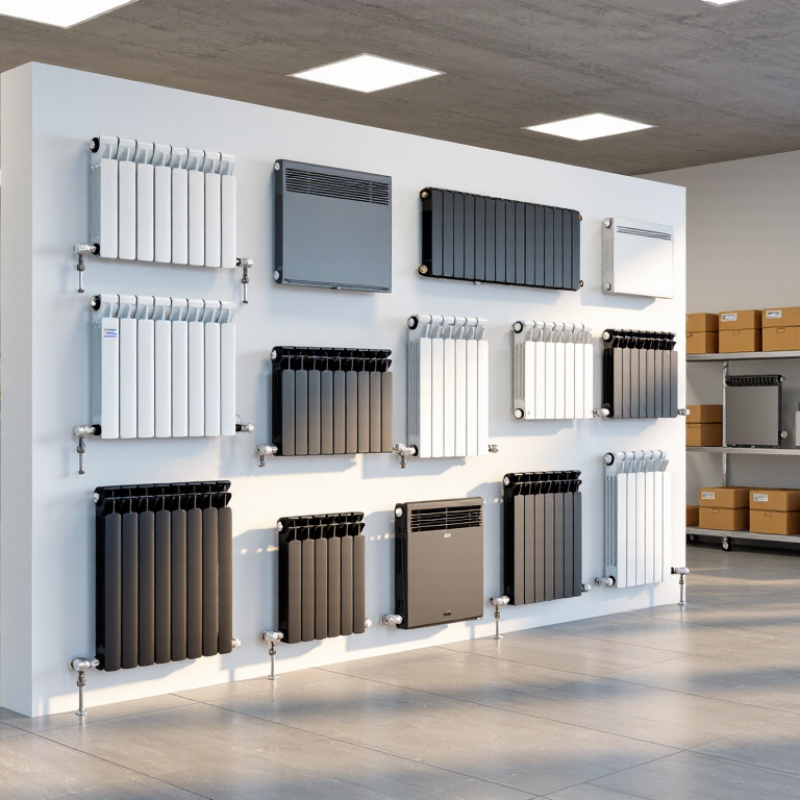
China Top 10 Steel Panel Radiator Manufacturers

Steel Panel Radiators Explained: EN 442 Heat Output at 75/65/20°C

Steel Panel Radiators are commonly compared underEN 442-2 conditions: 75/65/20°C. The water enters at 75°C, leaves at 65°C, and the room remains at 20°C. This creates a 50°C mean temperature difference, known as ΔT50. Reported heat output, such as 2,000 watts, is meaningful only when this test condition is clearly stated.

That rating can mislead low-temperature heating projects. At 55/45/20°C, ΔT falls to 30°C. Using a typical radiator exponent of 1.3, output becomes roughly 52% of the ΔT50 value. A 2,000-watt panel may provide only about 1,040 watts. Check the declared exponent. It varies slightly.

Small details matter.

The International Energy Agency’s The Future of Heat Pumps report states that modern heat pumps can deliver three to five units of heat per unit of electricity. Their efficiency improves with lower flow temperatures, but steel panels may need more surface area. Type 22 panels, with two convector sections, often provide greater output than slimmer Type 11 designs at similar heights. EN 442 testing supports fair comparison, yet installation conditions remain imperfect. Pipe resistance, wall insulation, valve settings, and actual room temperature can change performance. For China-based sourcing, request EN 442 test evidence, declared ΔT values, coating specifications, and batch inspection records. Catalog numbers alone are not enough.

China’s Steel Capacity: 1.019 Billion Tonnes of Crude Steel in 2023

China’s steel industry produced about 1.019 billion tonnes of crude steel in 2023. This scale supports a deep manufacturing base for steel panel radiators. It also creates demanding questions about consistency, energy use, and material traceability.

When reviewing China’s top ten steel panel radiator manufacturers, buyers should examine more than factory size. Production experience matters at every stage, from cold-rolled sheet selection to automated welding and powder coating. A reliable factory should provide material certificates, dimensional reports, pressure-test records, and clear quality-control procedures. Radiator panels need even seams, clean water channels, and a smooth coating without thin edges or visible pinholes. Small defects can become expensive after installation.

Testing against recognized heating standards, such as EN 442, can improve confidence in heat-output claims. Factory audits should also check calibration records, worker training, packaging strength, and batch traceability. A serious supplier can explain its steel grades and coating process without vague promises. That is a useful sign.

The huge steel capacity is an advantage, but it does not guarantee radiator quality. This point is easy to overlook. Some manufacturers may rely on external processing, while others control forming, welding, painting, and final inspection in one facility. Buyers should verify this difference through production videos, sample inspections, and independent testing. Even experienced purchasers can miss inconsistent coating thickness or weak packaging. Better decisions come from evidence, not impressive capacity figures.

Top 10 Chinese Steel Panel Radiator Manufacturers by Market Criteria

China Top 10 Steel Panel Radiator Manufacturers

A reliable top-ten list should use market criteria, not factory size alone. Production capacity matters, but stable quality matters more. Buyers should review export experience, delivery records, customization ability, and after-sales support. These factors reveal whether a manufacturer can serve long-term projects.

During factory evaluations, inspect weld lines, panel alignment, coating thickness, and packaging strength. Ask for recent pressure-test records and independent laboratory reports. Compliance with relevant heating standards also supports purchasing confidence.

Energy efficiency deserves attention, especially for residential projects with rising operating costs. Clear communication can prevent errors in dimensions, connections, and color finishes.

No ranking is permanent. Public information may be incomplete, and some smaller manufacturers offer excellent technical service. A practical comparison should examine production samples, response times, minimum order quantities, and replacement procedures. Buyers should also confirm steel thickness and corrosion protection before signing contracts. Details matter. One weak carton can damage finished radiators during shipping. A low price may hide slower support or inconsistent batches. Market performance should therefore be reviewed regularly, not treated as a fixed label.

Manufacturer Profiles: Product Range, ISO 9001, CE, and EN 442 Compliance

China’s top steel panel radiator manufacturers should be assessed through evidence, not attractive catalogues. Their product ranges may include single-panel, double-panel, and triple-panel radiators. Some also offer compact, vertical, and custom-sized models. A practical profile should state steel thickness, coating method, connection options, operating pressure, and heat output.

ISO 9001 certification indicates a controlled quality management system. It does not automatically guarantee flawless radiators. Check the certificate scope, issuing body, and current validity. CE marking should also be reviewed carefully against the applicable European requirements. EN 442 testing is more specific to radiator performance, including thermal output under defined conditions. Reliable manufacturers can provide test reports, technical drawings, and traceable batch information. Still, paperwork can be incomplete. That deserves questions.

Tips: Request EN 442 output data at your project’s design temperatures. Compare identical panel sizes, not only advertised wattage. Inspect welds, brackets, valve threads, and powder coating on samples. Confirm packaging details for long-distance transport. A factory visit or independent inspection adds useful experience, especially when specifications change late. Good suppliers usually explain limitations clearly, rather than promising every result.

How to Compare Radiators: Output, Working Pressure, Coating, and Warranty

When comparing China’s top steel panel radiator manufacturers, begin with verified heat output, not panel size. EN 442-2 measures output at a 50K temperature difference, commonly using 75/65/20°C conditions. A radiator rated at 2,000 watts may deliver far less in a modern 45/35/20°C system. Ask for output tables at your actual design temperatures. This is often missed.

Working pressure needs careful reading. Compare the maximum operating pressure, test pressure, and stated safety margin separately. Residential steel panels commonly show working pressures near 6–10 bar, but project requirements can differ. The IEA’s Energy Efficiency 2023 report states that buildings consume about 30% of global final energy, making low-temperature performance increasingly important. A higher output at lower water temperatures can reduce boiler demand, though product data may be optimistic.

Coating quality affects appearance and corrosion resistance. Request the pretreatment process, coating thickness, and test evidence under ISO 9227 or relevant internal specifications. Salt-spray hours are useful, but they do not perfectly predict bathroom or coastal service life. Warranty terms deserve the same scrutiny. Check coverage length, installation conditions, water-quality limits, and exclusions for modified pipe connections. Longer coverage is not automatically better. Some documents remain unclear.

China Top 10 Steel Panel Radiator Manufacturers - How to Compare Radiators: Output, Working Pressure, Coating, and Warranty
Rank Anonymous Manufacturer Profile Reference Radiator Configuration Heat Output at ΔT50 Maximum Working Pressure Hydrostatic Test Pressure Steel and Coating Specification Typical Warranty Specification Assessment
1 Profile A Type 22, 600 mm high, 1000 mm long; EN 442 test basis 1,850 W/m 10 bar 13 bar Cold-rolled steel panel, phosphated pretreatment, electrostatic epoxy-polyester powder coating, standard white similar to RAL 9016 10 years against manufacturing defects High-output specification
2 Profile B Type 22, 600 mm high, 1000 mm long; EN 442 test basis 1,800 W/m 10 bar 13 bar Low-carbon steel, multi-stage cleaning and phosphating, powder-coated finish with optional RAL color matching 10 years against material and workmanship defects Strong all-round specification
3 Profile C Type 22, 600 mm high, 1000 mm long; EN 442 test basis 1,760 W/m 10 bar 13 bar 1.2 mm nominal steel panel, anti-corrosion pretreatment, epoxy-polyester powder coating, smooth satin surface 8 years against manufacturing defects Balanced specification
4 Profile D Type 22, 600 mm high, 1000 mm long; EN 442 test basis 1,720 W/m 9 bar 12 bar Cold-rolled steel, degreasing and phosphate treatment, durable powder coating in white or selected standard colors 8 years against manufacturing defects Commercial-grade option
5 Profile E Type 22, 600 mm high, 1000 mm long; EN 442 test basis 1,690 W/m 9 bar 12 bar Low-carbon steel, electrophoretic or phosphated primer, polyester powder topcoat, standard RAL 9016-style white 7 years against material and workmanship defects Value-focused specification
6 Profile F Type 22, 600 mm high, 1000 mm long; EN 442 test basis 1,650 W/m 8 bar 10.5 bar Cold-rolled steel panel with anti-rust pretreatment and baked epoxy-polyester powder coating 7 years against manufacturing defects Suitable for standard systems
7 Profile G Type 22, 600 mm high, 1000 mm long; EN 442 test basis 1,620 W/m 8 bar 10.5 bar 1.1–1.2 mm steel panel, chemical pretreatment, powder-coated finish, corrosion-resistant internal water channels 6 years against manufacturing defects Practical mid-range option
8 Profile H Type 22, 600 mm high, 1000 mm long; EN 442 test basis 1,580 W/m 8 bar 10 bar Cold-rolled steel, phosphate pretreatment, polyester powder coating, white finish with optional custom colors 6 years against manufacturing defects Economical specification
9 Profile I Type 22, 600 mm high, 1000 mm long; EN 442 test basis 1,540 W/m 8 bar 10 bar Low-carbon steel, cleaned and phosphated surface, thermosetting powder coating, standard white finish 5 years against manufacturing defects Basic export specification
10 Profile J Type 22, 600 mm high, 1000 mm long; EN 442 test basis 1,500 W/m 6 bar 9 bar Cold-rolled steel, standard anti-corrosion pretreatment, epoxy-polyester powder coating, white finish 5 years against manufacturing defects Entry-level specification

Comparison basis: heat output is shown per metre for a Type 22 steel panel radiator at a 600 mm height and ΔT50, where ΔT50 means a 50 K difference between the average radiator water temperature and room air temperature. Actual output varies with radiator length, height, type, connection method, water temperature, and testing standard. Always verify the final technical datasheet, pressure rating, coating system, and warranty terms before purchase.

WhatsApp