
China Top 10 CNC Machine Parts Manufacturers?

China has become a major sourcing hub for Cnc Machine Parts, serving automation, robotics, medical equipment, and industrial machinery markets. Its manufacturers range from high-volume turning factories to specialized suppliers producing hardened shafts, aluminum housings, gears, brackets, and precision assemblies.

Mikell P. Groover, a respected manufacturing professor and author, defines the field clearly: “Manufacturing is the transformation of materials into products of greater value by means of one or more processing and/or assembly operations.” This principle matters when evaluating Chinese suppliers. A capable manufacturer should control material certificates, machining tolerances, surface finishes, heat treatment, and final inspection. Practical evidence may include CMM reports, process records, ISO 9001 certification, and production samples measured against approved drawings.

This guide examines ten leading China-based manufacturers through useful purchasing criteria. These include CNC equipment, engineering support, batch capacity, export experience, quality systems, communication, and delivery performance. The list is not absolute. No ranking can represent every buyer’s requirements.

A factory may produce excellent prototypes but struggle with repeat production. Another may offer competitive pricing while lacking transparent inspection records. That difference matters.

Readers should verify current certifications, factory capabilities, sample quality, and contractual terms before placing an order. Tolerances on paper are not enough. Ask how the supplier measures them.

The selected companies are presented as potential partners, not automatic choices. Careful comparison remains necessary, especially for safety-critical or high-precision Cnc Machine Parts. Manufacturing conditions change, and even a strong supplier can deliver inconsistent results without clear specifications and active quality control.
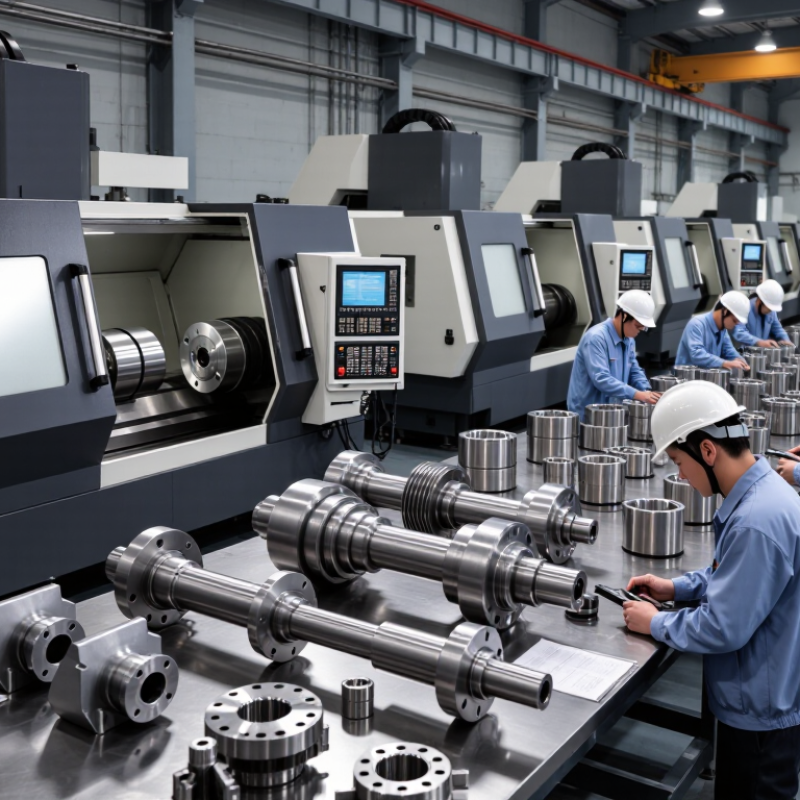
China Top 10 CNC Machine Parts Manufacturers?

What Are CNC Machine Parts and Why Do They Matter?

CNC machine parts are the working elements inside a computer-controlled machine tool. They include spindles, guide rails, ball screws, tool holders, bearings, motors, sensors, and cutting tools. Each part performs a specific task, but their accuracy depends on how well they work together. A spindle may rotate smoothly, yet worn bearings can create vibration and poor surface finishes. A guide rail can look clean while hidden friction reduces positioning accuracy.

Small parts matter greatly. A ball screw with slight backlash may produce visible errors on a precision component. Sensors also protect the process by detecting position, temperature, or tool movement. In practical production, engineers check hardness, dimensional tolerance, lubrication, alignment, and material certificates. They also inspect parts under real operating loads, not only on a workbench. That detail is easy to overlook.

Reliability is more than a low price. It involves stable performance, traceable inspection records, and suitable maintenance support. A part that fits today may fail early if its coating, heat treatment, or sealing quality is inconsistent. Not every fault is obvious. This is where technical judgment matters. Production teams sometimes replace a part too quickly, when misalignment caused the damage. Other times, they blame maintenance when the component specification was incomplete. Better decisions come from measuring vibration, temperature, runout, and wear before changing anything. Mistakes still happen. Careful evidence makes them less expensive.

China Top 10 CNC Machine Parts Manufacturers? What Are CNC Machine Parts and Why Do They Matter?

CNC machine parts determine positioning accuracy, cutting stability, durability, and production efficiency. The chart below shows representative material densities commonly associated with major CNC machine-part applications.

Density values are representative engineering reference values in g/cm³. Actual values vary by material grade, heat treatment, coating, and component design.

How to Evaluate CNC Machine Parts Manufacturers in China

Choosing among China’s top ten CNC machine parts manufacturers requires more than a polished catalog. Start with traceability: material certificates, heat-treatment records, inspection plans, and controlled drawings. The 2024 China Machine Tool Industry Association report showed continued domestic industry activity, but growth does not prove supplier consistency. Ask for three recent batches, not one perfect sample. Measure bores, surface finish, runout, and hardness with calibrated equipment. Keep the reports.

Technical evaluation must match your application. For precision shafts, request CMM results, concentricity data, and gauge repeatability studies. For aluminum housings, inspect porosity controls and thread protection. The ISO Survey 2023 recorded over 1.2 million ISO 9001 certificates worldwide. Certification supports discipline, but it cannot replace factory evidence. Check calibration labels, nonconformance logs, subcontracting controls, and corrective-action timing. A fast reply is useful. A closed corrective action is better.

Commercial evidence matters too. Compare tooling assumptions, scrap allowances, packaging, and six-month delivery records. UNCTAD’s Review of Maritime Transport 2024 reported maritime trade growth of 2.4% in 2023, while freight conditions remained unstable. Landed cost deserves more attention than unit price. Request a pilot order with written acceptance limits. Visit the facility or arrange a live video audit. Note uncomfortable details. Mixed materials and vague answers deserve investigation. A supplier may pass one sample inspection and still fail at volume. Recheck that risk with quarterly scorecards covering defects, delivery accuracy, response time, and engineering changes.

China Top 10 CNC Machine Parts Manufacturers? – How to Evaluate CNC Machine Parts Manufacturers in China
A practical, brand-neutral evaluation framework for comparing Chinese CNC machine parts manufacturers.
No. Evaluation Dimension What to Verify Relevant Evidence or Reference Practical Evaluation Benchmark Suggested Weight
1 Machining Capability Available CNC milling, turning, Swiss-type, grinding, EDM, and five-axis equipment; maximum workpiece size; axis travel; spindle speed; and supported materials. Current machine list, equipment photographs, machine specifications, and sample parts made from comparable materials. Equipment capability should match the drawing requirements without relying on unverified subcontracting. 15%
2 Dimensional Accuracy and Tolerance Control Ability to maintain drawing tolerances, geometric tolerances, concentricity, flatness, perpendicularity, and surface-finish requirements during production. ISO 1101ISO 2768ISO 286
Inspection reports and first-article measurement results.
The supplier should demonstrate measured results against the actual part drawing, not only general machine accuracy claims. 15%
3 Quality Management System Documented procedures for incoming inspection, process control, final inspection, nonconformance handling, corrective action, and internal audits. Valid third-party certificate, certificate scope, audit records, quality manual, and corrective-action examples. A valid ISO 9001 quality management system is a useful baseline; certificate scope and validity should be checked independently. 12%
4 Inspection and Metrology Availability of CMM, height gauges, roundness testers, surface roughness testers, hardness testers, and calibrated gauges. Equipment calibration certificates, inspection plans, CMM reports, gauge records, and measurement-system procedures. Critical dimensions should be measured with calibrated equipment suitable for the required tolerance and geometry. 12%
5 Material Control and Traceability Material purchasing controls, grade verification, heat or lot traceability, certificates of conformity, and segregation of materials. Mill test certificates, material labels, purchase records, heat numbers, and traceability records linking material to finished parts. Material certificates should identify the material grade, applicable specification, batch or heat number, and test results where required. 10%
6 Production Capacity and Lead-Time Control Available production hours, staffing, machine utilization, bottleneck processes, capacity planning, and ability to support prototype-to-volume transitions. Capacity plan, production schedule, historical delivery records, workflow chart, and contingency arrangements for critical operations. Lead times should be confirmed by process route, quantity, material, finishing, inspection requirements, and shipping terms rather than quoted as a fixed standard. 10%
7 Surface Treatment and Secondary Operations In-house or controlled external services for anodizing, plating, passivation, heat treatment, coating, laser marking, deburring, and assembly. Process specifications, approved-subcontractor list, treatment certificates, thickness reports, hardness results, and color or appearance standards. Every outsourced process should have defined specifications, acceptance criteria, and documented final verification. 8%
8 Engineering and Drawing Support Ability to review GD&T, identify manufacturability risks, recommend tolerances, optimize fixturing, and manage revisions securely. DFM feedback, engineering-change procedure, revision-controlled drawings, technical communication records, and sample process plans. The manufacturer should identify unclear datums, unnecessary tolerances, difficult features, and inspection risks before production starts. 7%
9 Regulatory, Environmental, and Export Compliance Compliance with applicable product, material, environmental, worker-safety, packaging, and export requirements for the destination market. RoHSREACHISO 14001ISO 45001
Declarations, test reports, permits, and compliance records where applicable.
Requirements should be evaluated according to the destination country, end use, material, coating, and customer documentation requirements. 6%
10 Commercial Reliability and Risk Control Quotation clarity, payment terms, intellectual-property protection, communication speed, warranty terms, dispute handling, and business continuity. Detailed quotation, purchase agreement, NDA, quality agreement, customer references, factory audit findings, and documented escalation contacts. A reliable supplier provides transparent assumptions, written acceptance criteria, stable communication, and a defined remedy for nonconforming parts. 5%

China’s Top 10 CNC Machine Parts Manufacturers

China’s Top 10 CNC Machine Parts Manufacturers are often judged by more than production volume. Reliable suppliers show consistent tolerances, documented inspections, and stable material sourcing. Their workshops may produce aluminum housings, stainless steel shafts, brass fittings, and custom assemblies. Details matter.

Experienced buyers should examine process control before comparing prices. Ask for sample reports, measuring equipment records, and evidence of operator training. A capable manufacturer can explain its milling, turning, grinding, and surface-finishing limits clearly. It should also confirm tolerance requirements before production begins. Small errors grow.

Tips: Send precise drawings with material grades, tolerances, surface finishes, and inspection points. Request a first-article sample before approving larger quantities. Check how the supplier handles tool wear, rejected parts, packaging, and delivery changes. Photos help, but measurement records are stronger evidence. Ask for evidence.

A dependable shortlist should include manufacturers with traceable quality procedures and practical engineering support. Look for clear communication about lead times and production risks. Factory experience matters, yet it does not guarantee every project will run smoothly. I would still test a supplier with a modest batch, especially for tight-tolerance parts. Some evaluations overlook packaging, but scratched surfaces or mixed batches can create expensive problems after arrival.

What Products and Industries Do These Manufacturers Serve?

China’s leading CNC machine parts manufacturers supply more than replacement components.
Their product ranges commonly include spindle assemblies, ball screws, linear guides, tool holders, precision shafts, machine beds, protective enclosures, and custom fixtures. Some also produce hydraulic manifolds and robotic end-effectors. These parts support both new equipment and factory maintenance.

According to Grand View Research, the global CNC machine market was estimated at about USD 88 billion in 2023, with continued growth expected through 2030. This demand reaches electronics, automotive, aerospace, medical devices, energy equipment, and general engineering. Automotive plants often require high-volume transmission and engine components. Medical manufacturers need small, clean, tightly controlled parts. Aerospace buyers usually prioritize traceability, material certificates, and stable tolerances over low prices.

China’s industrial ecosystem strengthens this supply chain. The International Federation of Robotics reported 276,288 industrial robot installations in China during 2023. CNC components increasingly serve automated assembly, inspection, and material-handling systems. A practical supplier should provide inspection reports, surface-finish records, dimensional data, and support for materials such as aluminum, stainless steel, titanium, and engineering plastics. Catalog breadth is not proof of capability. I have seen apparently similar parts fail because heat treatment or tolerance control was overlooked. The boundary is not always clean. Buyers should verify batch consistency, communication quality, and after-sales engineering support before approving production.

How to Choose the Right Chinese CNC Parts Manufacturer

Choosing among China’s top 10 CNC machine parts manufacturers requires more than comparing prices. Start with the drawing, material grade, tolerance, and yearly quantity. A capable supplier should explain how it controls critical dimensions. Request inspection records, material certificates, and sample measurements. Ask whether a coordinate measuring machine checks complex features.

Small tests matter. Order a prototype before approving mass production. Check threads, surface finish, burr removal, and packaging. A reliable manufacturer will discuss weaknesses instead of promising perfection. Clear communication also matters, especially when drawings change across time zones.

Visit the factory remotely or in person when possible. Review machining centers, tool calibration, quality procedures, and production capacity. Ask who handles nonconforming parts. Their answer may reveal more than a sales presentation. Confirm lead times in writing, including inspection and shipping delays.

Cost comparisons can mislead. A low unit price may hide expensive rework, poor packing, or unstable tolerances. I have sometimes focused too heavily on equipment lists. Later, process discipline proved more important. A newer machine does not guarantee better parts. Require a small batch with defined acceptance criteria, then evaluate actual results.

Protect technical information through a clear contract. Confirm ownership of drawings, confidentiality duties, payment terms, and dispute procedures under applicable law. Choose a supplier that provides traceability from raw material to final inspection. The best decision may feel slower at the beginning. It usually creates fewer surprises during production.

WhatsApp