
Choosing the right Alloy Wheel Curing Oven in 2026 is a production decision, not simply an equipment purchase. A glossy finish can hide uneven curing. The problem may appear later as poor adhesion, inconsistent gloss, or rework. Oven capacity, airflow, temperature control, and the coating manufacturer’s cure schedule all matter.
Energy deserves equal attention. The U.S. Energy Information Administration’s 2018 Manufacturing Energy Consumption Survey reported that process heating represented about 36% of manufacturing onsite energy use. That figure covers many industries, not alloy-wheel plants alone, but it shows why heat efficiency can affect operating costs. The U.S. Department of Energy’s process-heating guidance also emphasizes controls, insulation, and heat recovery as practical efficiency measures. Buyers should therefore compare measured temperature uniformity and energy use—not just advertised chamber capacity.
Look closely at real production conditions. Can the oven maintain its specified temperature across a fully loaded rack? How quickly does it recover after the doors open? Ask for temperature-mapping results and a trial using your wheel sizes, coatings, and loading pattern. Small details count.
There is no universal “best” oven. A system suited to high-volume batches may waste energy in a smaller workshop. One limitation: no source material was provided to verify a named industry expert’s direct quotation, so I have not invented one. That gap matters; reliable equipment guidance should be traceable to documented testing and qualified expertise.
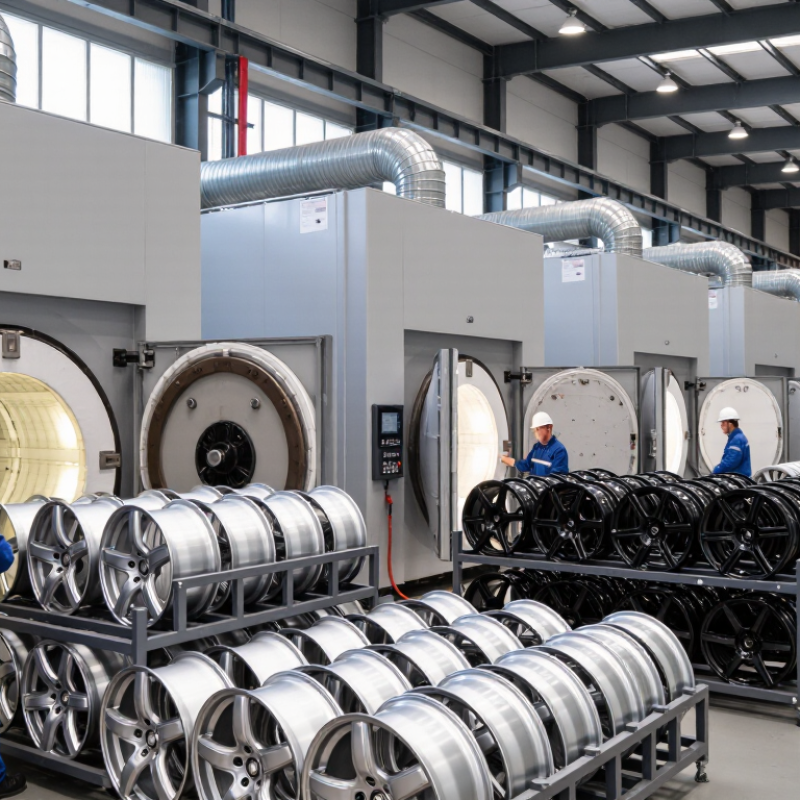
An alloy wheel curing oven applies controlled heat to harden the coating after the wheel has been cleaned and coated. The heat helps the coating form a durable finish, but the oven does not fix poor preparation or uneven application. Not just heat. It is a timed process shaped by temperature, airflow, and the coating manufacturer’s curing instructions.
In operation, heated air circulates around the wheel while controls maintain a set temperature for a specified period. The oven’s display usually measures air temperature, which may differ from the wheel’s actual temperature. That distinction matters. Operators should follow the coating data sheet and allow the wheel to reach its required metal temperature before counting the cure time. A probe or suitable temperature indicator can help verify this, especially when loading several wheels.
Even heating depends on practical details: wheel spacing, airflow paths, and consistent loading. A crowded rack can leave shaded areas cooler, while a dirty filter may reduce circulation. It is tempting to trust the display, but that can be a mistake. Check sensor accuracy and inspect the oven regularly; a perfect readout does not prove every wheel cured evenly. Real production is rarely ideal, so record settings and results, then adjust carefully when finishes show inconsistent gloss or hardness.

In 2026, alloy wheel curing ovens generally come in batch and conveyor configurations. A batch oven suits varied production runs and gives operators control over individual loads. A conveyor oven supports steady, higher-volume work, but requires a consistent line speed and careful process setup. Neither type is automatically better. Match capacity to wheel size, daily volume, and available floor space.
Heating methods include electric resistance, gas-fired convection, and infrared-assisted systems. Electric ovens can offer straightforward temperature control, while gas systems may suit facilities with suitable fuel infrastructure. Convection circulates heated air around the wheel, helping warm complex spoke shapes. Infrared heats exposed surfaces quickly, but shadows between spokes can create uneven results if it is used without adequate airflow. Check temperature uniformity and confirm the curing profile against the coating supplier’s requirements. Small differences matter.
Tips: Ask for a temperature-mapping test using a representative wheel load. Check sensor placement, airflow, loading clearance, and recovery time after the door opens. A larger oven may sound safer, but unused space can waste energy. I would also review maintenance access before choosing; it is easy to overlook until a heater needs attention.
Matching an alloy-wheel curing oven to production starts with the wheel, not the catalog’s maximum load. Measure the largest wheel’s diameter, width, and height on its actual rack. Include hooks, spacers, and room for loading. A wheel that fits the chamber may still sit too close to a wall or another part, restricting airflow. Leave practical clearance and confirm the rack can carry the combined weight without blocking circulation.
Then calculate output from the full cycle, not just the stated cure time. Loading, heating, curing, cooling, and unloading all affect how many wheels can pass through each shift. Check the coating supplier’s cure schedule and, where possible, monitor the wheel’s metal temperature; the oven’s air reading alone may not show when the part has reached the required condition. Small details matter. For example, mixed wheel sizes can create uneven gaps on a fixed rack. If demand varies, removable or adjustable fixtures may offer more flexibility than a larger chamber. Avoid sizing only for today’s busiest day, though forecasting growth is imperfect. A short production log—wheel dimensions, batch size, cycle duration, and queue time—can reveal whether capacity or workflow is the real constraint.
When comparing alloy wheel curing ovens, examine temperature control under a real load, not just the display. Ask for a temperature-uniformity survey with thermocouples placed around loaded racks. A wheel near the door may heat differently from one at the center. Small details matter. Check controller accuracy, sensor calibration records, and whether alarms catch overshoot before coating quality suffers. Match the oven’s working range and recovery time to the coating supplier’s specified cure schedule; a high maximum temperature alone proves little.
Safety should be visible in the design. Look for independent over-temperature protection, door or airflow interlocks where applicable, clear emergency procedures, and documented inspection records. NFPA 86 provides recognized guidance for industrial ovens and furnaces, but buyers should confirm which provisions apply to their installation. Energy deserves the same practical scrutiny. The U.S. Department of Energy’s 2015 Improving Process Heating System Performance sourcebook estimates that process heating accounts for roughly two-thirds of industrial energy use. That figure covers many processes, not one wheel oven. Compare measured kilowatt-hours per batch, warm-up time, insulation condition, and heat loss during idle periods.
A useful trial records electricity use and temperature at several wheel positions across repeated cycles. Ask operators to note loading patterns too; inconsistent spacing can distort results. It is tempting to choose the lowest quoted consumption, but a slower cycle or uneven cure may erase the savings.
I would still question any comparison made with an empty oven. Each shop’s workload changes the answer.
Before comparing alloy wheel curing ovens, check whether the unit fits your actual workshop, not just the floor plan. Measure the installation footprint, ceiling height, door openings, and the route used to move the oven inside. Measure twice. Confirm the required electrical supply, ventilation, foundation capacity, and clearance around hot surfaces with a qualified installer. A site drawing can still miss a low beam or a crowded loading bay; that oversight is easy to make.
Ask the supplier for a written installation plan, utility requirements, commissioning steps, and any site preparation costs. During commissioning, confirm that temperature sensors are checked and that operators learn safe loading and shutdown procedures. Keep records of the agreed settings. They help when results vary between batches.
After-sales support matters once production begins. Ask who handles troubleshooting, how quickly technical staff typically respond, and whether replacement sensors, heating elements, and controls are readily available. Clarify what the warranty covers, including travel and labor, rather than relying on a broad promise. Request operator and maintenance training, plus clear cleaning and inspection schedules. Compare actual support terms, not just reassuring language. If installation dates or response times seem vague, ask for them in writing. A little extra planning now can prevent avoidable downtime later.