
How to Choose the Best Automatic Pergola?

Choosing an Automatic Pergola is not just a style decision. It affects shade, comfort, maintenance, and how often you use your patio. Houzz’s 2024 U.S. Outdoor Trends Study reported a $2,000 median spend on outdoor projects, showing that homeowners are investing in these spaces. That figure covers outdoor projects broadly, not pergolas alone. Still, it offers useful context: a motorized roof deserves careful comparison before purchase.

Joe Raboine, Belgard’s director of hardscapes and an outdoor-living specialist, has described outdoor areas as extensions of the home. That idea is a helpful guide, rather than a verified verbatim quotation. Consider the space at different times of day. Does afternoon sun reach the dining table? Where does rain run off the slats? Can you reach the controls from your usual seating area? Small details matter.

A good choice fits real routines. It should also match local weather, installation conditions, and your maintenance expectations. Check the frame and finish, motor and controls, drainage design, warranty terms, and available service. Ask suppliers how the system performs in wind and rain, and request written specifications. Do not rely on showroom appearance alone. A sleek louvered roof may look impressive, but its value depends on how reliably it works at home. The sections below explain how to compare the options and choose with confidence.
How to Choose the Best Automatic Pergola?

Define Your Space, Climate, and Intended Use

How to Choose the Best Automatic Pergola?

Define Your Space, Climate, and Intended Use

Start with the space you actually use, not just its dimensions. Measure the patio, note door swings, drainage, and nearby branches, then mark where chairs and a dining table will sit. Real patios are rarely perfect rectangles; a drain or low eave can make a planned layout awkward. Decide whether you mainly want shade for lunch, shelter for reading, or a flexible area for guests. Measure twice.

Climate should shape the opening mechanism and roof material. Check local seasonal rainfall, prevailing winds, and summer sun angles before comparing options. NOAA’s 1991–2020 U.S. Climate Normals provide location-specific temperature and precipitation data; ASHRAE climatic design data can help assess outdoor conditions. For sun exposure, the U.S. Department of Energy reports that window awnings can reduce summer solar heat gain by up to 65% on south-facing windows and 77% on west-facing windows. Those figures apply to windows, not pergolas, but they show why orientation matters. Rain changes everything. Ask how the system handles runoff, gusts, and snow, and follow its rated operating limits.

Tips: Sketch the space at full scale with tape or chalk. Note the hottest afternoon corner. If you will dine outside, check whether the open roof still leaves enough shade at mealtime. A slightly imperfect sketch beats guessing from a photo.

Compare Automatic Pergola Roof and Control Systems

How to Choose the Best Automatic Pergola?

Compare Automatic Pergola Roof and Control Systems

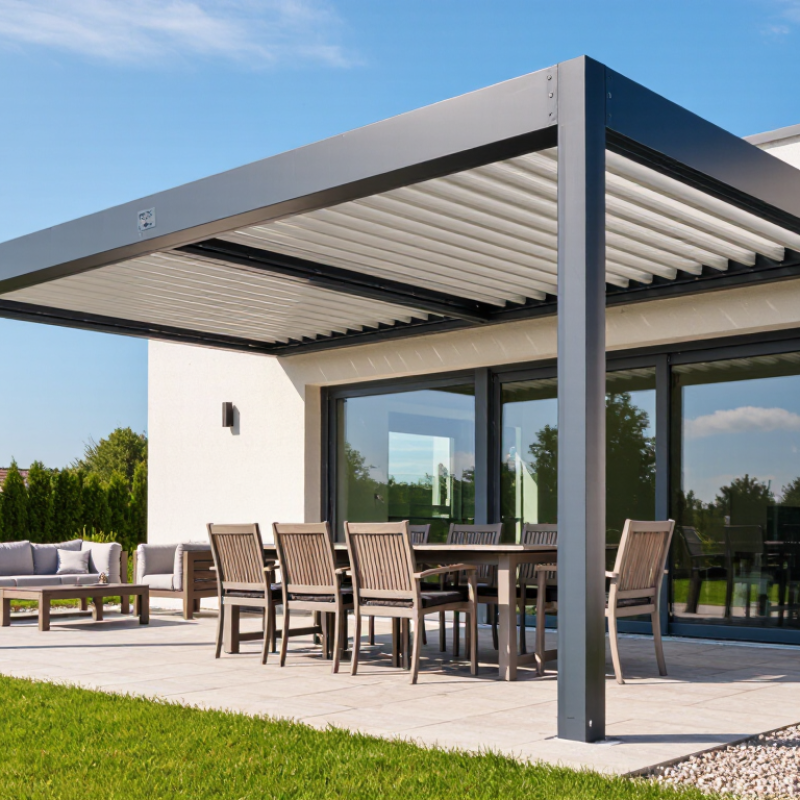
An automatic pergola’s roof affects shade, airflow, and rain protection. Adjustable louvers tilt to let warm air escape, while a retractable roof opens more fully for direct sunlight. Neither design suits every patio. Consider how afternoon sun reaches your seating area, and whether wind or frequent rain is common. A small mock-up with chairs can reveal awkward shade patterns before installation. It is easy to overlook that detail.

Control systems deserve equal attention. A wall switch is simple and dependable, especially when several people use the space. A remote offers convenient operation from a chair, while app-based controls may support scheduling or sensor responses. Rain and wind sensors can reduce the need to react quickly, but they still require correct setup and maintenance. Ask about manual operation during a power outage, wiring access, and how sensors behave in gusty conditions. I would not assume the most automated option is always the most practical; one extra step can be worth the reliability.

Tips: Test controls before committing, and check whether they work from your usual seating spot. Compare operating noise, response time, and maintenance needs. Keep it simple if you prefer fewer settings.

Assess Frame Materials, Durability, and Weather Resistance

An automatic pergola’s frame must handle more than its own weight. Powder-coated aluminum is relatively light and resists rust, but chipped coating can expose the metal beneath. Check corners, fasteners, and cut edges for even coverage. Steel can feel reassuringly rigid, yet scratches and neglected joints may corrode. Timber brings warmth, though it needs regular sealing and checks for splitting or swelling. Details matter.

Heavier does not automatically mean stronger. Ask for frame dimensions, anchoring guidance, and wind or snow ratings for the exact configuration. These ratings vary by model and installation, so avoid assuming a pergola suits your site without checking. In coastal air, salt can speed corrosion; near trees, leaves may clog drainage channels. Look for sloped gutters, accessible outlets, and louvers that close firmly. A motor’s weather protection matters too, especially where rain can collect around wiring or housings. Not always obvious.

Before choosing, consider the weather the structure will actually face: gusts, driving rain, frost, or intense sun. A sheltered patio and an exposed rooftop need different levels of protection. Ask how often moving parts, seals, and finishes need inspection. I’d also leave room for doubt: published ratings cannot account for every poor anchor or blocked drain. A careful installation and simple maintenance routine can matter as much as the frame material.

How to Choose the Best Automatic Pergola? — Assess Frame Materials, Durability, and Weather Resistance A practical comparison of common frame materials for motorized pergolas
Frame Material Durability Weather and Corrosion Resistance Maintenance Key Considerations for an Automatic Pergola
Powder-coated aluminum Strong for its weight and generally resistant to rot and insect damage. Performance depends on the frame design, alloy, finish, and installation. Does not rust like ordinary steel. A sound exterior-grade coating helps protect the surface; salt and airborne pollutants can still affect finishes and hardware. Usually low. Clean periodically with mild soap and water, and inspect coatings, fasteners, and moving parts. Light weight can simplify support requirements. Check that the frame and motorized roof system are engineered together, especially for wind loads.
Galvanized or coated steel High strength and stiffness, which can suit designs needing robust structural members. Protective layers can be damaged by cuts, scratches, or poor detailing. Galvanizing and suitable exterior coatings help slow corrosion. Exposed or damaged areas may rust, particularly in persistently damp or coastal environments. Inspect coatings and joints; repair damaged protective finishes promptly. Keep drainage paths clear to reduce standing water. Its weight and strength may require substantial supports. Confirm corrosion protection, connection details, and the structure’s suitability for the local climate.
Durable hardwood Can perform well outdoors when an appropriate species and sound construction are used. Natural variation, moisture movement, and biological decay affect performance. Varies by species and exposure. Rain, humidity, and direct sun can cause weathering, movement, and surface checking; detailing and finish influence protection. Typically higher than metal. Inspect regularly and maintain any stain, oil, or other finish according to its instructions. Wood movement and the weight of the structure should be considered when aligning tracks, louvers, or other motorized components.
Pressure-treated softwood Treatment can help protect wood from decay and insects, but it does not eliminate the need for correct design, drainage, and maintenance. Outdoor suitability depends on the treatment level, cut-end protection, exposure, and moisture management. The wood can still weather and move. Check for moisture-related wear, loose connections, and finish deterioration. Recoat as needed and follow treatment-product guidance. Often an economical option, but verify structural suitability and allow for dimensional changes that could affect moving roof parts.

Selection tip: No frame material alone guarantees wind, snow, or storm resistance. Ask for project-specific structural information and follow local building requirements. Also check the motor, fasteners, coatings, drainage, and maintenance instructions as part of the complete system.

Check Installation Requirements and Smart Features

An automatic pergola should fit the site before it impresses with features. Check the wall or posts that will carry its load, and ask an installer to inspect the structure rather than assume it is sound. Measure the opening, including space for moving louvers or a retractable roof. Plan drainage, cable routes, and access to a power supply. Wind exposure matters. So does water runoff near doors and foundations. A small oversight can become an expensive one.

Smart controls are useful when they solve a daily problem. Rain sensors can close the roof automatically, while wind sensors may retract vulnerable fabric. Look for a manual override, clear sensor settings, and control options that still work if Wi-Fi drops. Parks Associates reported in 2023 that 45% of U.S. internet households owned at least one smart-home device. That suggests connected controls are familiar to many buyers, but compatibility and setup still vary. Ask how the system handles outages, updates, and shared household access.

Tips: Before ordering, sketch the pergola’s footprint and mark nearby drains, outlets, and door swings. Request written confirmation of installation clearances and sensor behavior. And test the controls in person, if possible. A polished app can still feel awkward outdoors.

Compare Total Costs, Warranties, and Maintenance Needs

Compare the full installed price, not just the pergola’s listed cost. Ask whether the quote includes delivery, footings, wiring, drainage changes, and labor. A motorized louver system may need a suitable electrical connection, while a retractable canopy has different moving parts. Request an itemized estimate and compare the same dimensions and features. Small omissions add up.

Read the warranty terms closely. Coverage may differ for the frame, finish, motor, and controls. Check how long labor is covered, who handles service, and whether routine upkeep affects coverage. That matters. A long warranty is less useful if it excludes the part most likely to need attention. Keep a copy of the terms and ask for unclear exclusions in writing.

Maintenance affects cost over time. Louvers may need occasional cleaning around hinges and drainage channels; fabric systems may require gentle cleaning and careful drying. Ask how often the maker recommends inspections, and whether replacement parts remain available. One estimate can still miss site-specific work, so leave room in the budget. I’d also consider who will clean high or hard-to-reach areas. The cheapest option may become tiring to maintain.

WhatsApp