
China Top 10 Plastic Gear Manufacturers?

Plastic Gears are no longer limited to low-load toys or simple household mechanisms. They operate in automotive actuators, medical devices, office equipment, and compact industrial systems. Their appeal is practical: low mass, quiet running, corrosion resistance, and the ability to mold complex shapes. But a polymer gear can still fail through wear, heat, creep, or poor lubrication. Material choice matters. So do tooth geometry, load cycles, and manufacturing consistency.

Industry reports help explain the market, but they do not certify individual suppliers. Grand View Research’s Plastic Gears Market Size, Share & Trends Analysis Report reviews market segments and growth drivers. MarketsandMarkets’ engineering plastics research adds useful context on materials used in demanding components. Neither report should be treated as a quality ranking. A supplier’s sample inspection, test data, and application experience still matter.

This guide compares ten manufacturers by product range, technical capability, quality evidence, and customer fit. Gear-design specialist Dr. Hermann J. Stadtfeld’s published work offers a relevant engineering perspective, but I could not verify a verbatim quotation from him about plastic gears. Inventing one would weaken the reliability of this article. The comparison is not perfect; public supplier data varies, and some companies disclose more than others. Readers should confirm tolerances, resin grades, noise targets, and service-life claims directly before selecting a partner.
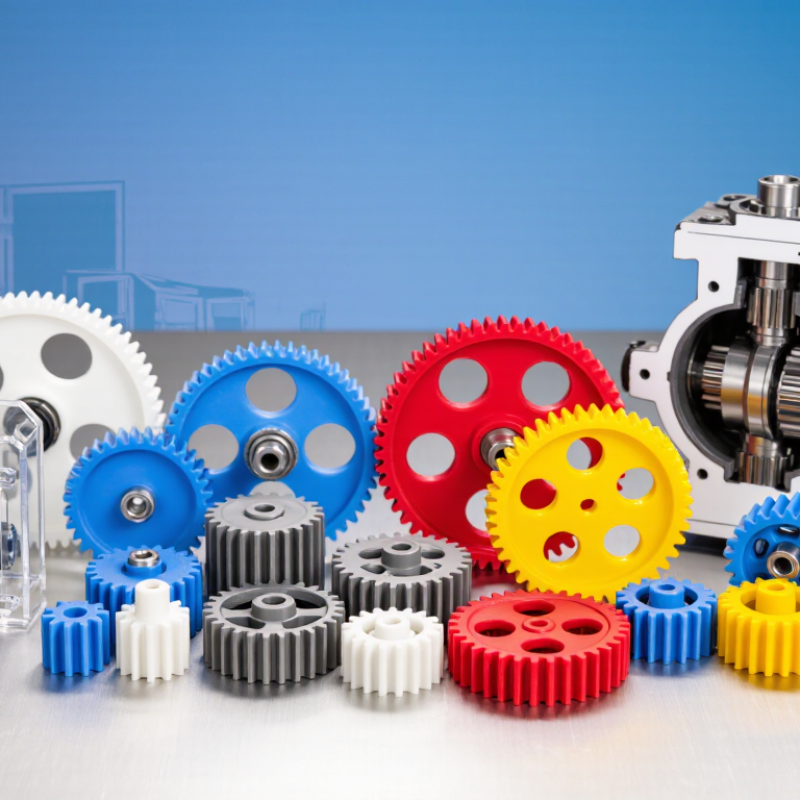
China Top 10 Plastic Gear Manufacturers?

What Plastic Gears Are and How They Are Used

Plastic gears transfer rotational motion between shafts through meshing teeth. They are commonly molded from engineering polymers, though some designs are cut from plastic stock. Compared with metal gears, many plastic versions are lighter, resist corrosion, and can run quietly with little lubrication. Performance depends on load, speed, temperature, tooth shape, and material choice. Not every plastic gear is silent.

You may find plastic gears inside household appliances, office printers, toys, small pumps, and precision instruments. A compact spur gear can drive a printer roller; a worm gear can turn a slow-adjustment knob.

Designers choose them when low weight, reduced noise, or efficient high-volume production matters. Plastic gears can also pair with metal gears. Heat and sustained loads may cause wear or deformation, so a gear that works in a desk device may fail inside a hot enclosure. That detail is easy to overlook.

Tips: Match the material to the operating temperature and expected load. Check shaft alignment and tooth contact; uneven wear can point to a setup problem. Test a sample under real operating conditions when possible. Measurements help, but actual use can still surprise you.

How China’s Plastic Gear Manufacturing Industry Works

China’s plastic gear industry connects design, material selection, tooling, production, and inspection. Buyers typically provide details about load, speed, noise, temperature, and expected service life. Engineers use these requirements to set tooth geometry, tolerances, and polymer choices. Small details matter. A gear may look simple, yet fail early if its hub, shaft fit, or lubrication needs are overlooked.

Common materials include acetal, nylon, and reinforced engineering plastics. No resin suits every application. Moisture can change dimensions, while heat may soften a gear. Added fibers can improve stiffness but increase wear on mating parts. Tooling teams design injection molds, where gate placement, cooling, and shrinkage affect accuracy. For small batches or revised parts, machining may be practical, though each piece can cost more. Testing is essential.

Quality checks may cover tooth profiles, runout, dimensions, and noise. Manufacturers can also test gears under representative loads and temperatures. Reliable production records include material batches and process settings, along with clear limits on what testing proves. I would not treat a smooth sample as proof of durability. A pilot run in the actual assembly can reveal backlash, noise, or wear that a drawing misses.

Criteria for Evaluating Chinese Plastic Gear Manufacturers

A “top ten” list is only a starting point; the right supplier depends on your gear’s load, environment, and volume. Check whether the manufacturer can explain its design and production controls in clear, practical terms. Ask about materials, tooth accuracy, dimensional inspection, and how defects are recorded. For a small gear, even a slight bore variation can affect fit. Request sample parts and inspection data, not just a capability brochure. Good evidence matters.

Evaluate experience with comparable gears, not simply years in business. Ask how the team handles wear, noise, heat, and changes in operating conditions. Material choice can shift performance: nylon, acetal, and other engineering plastics behave differently under moisture and sustained load. Confirm that proposed materials and tolerances suit your application. Review tooling ownership, realistic lead times, batch consistency, and communication during design changes. A polished sample is not proof of stable production. I would still verify the process on a pilot order; that step can feel slow, but skipping it is a common regret.

Tips: Send a drawing with critical dimensions clearly marked. Share expected speed, load, and operating temperature. Compare sample measurements with the drawing, and ask what happens when results fall outside tolerance. Keep the test simple, repeatable, and documented. A spreadsheet helps, but it cannot replace a useful technical conversation.

Profiles of 10 Leading Plastic Gear Manufacturers in China

Profiles of 10 Leading Plastic Gear Manufacturers in China

China’s plastic gear suppliers serve applications ranging from compact pumps to automotive actuators. Comparing ten manufacturers is more useful when profiles cover material selection, molding precision, machining options, and inspection practices—not just factory size.

Plastics Europe’s Plastics—The Fast Facts 2024 reports 413.8 million tonnes of plastics produced worldwide in 2023, with China accounting for 33.3 percent. That scale matters, but it does not prove gear-making expertise.

Tolerance matters. Ask how suppliers measure tooth geometry and control shrinkage between production batches.

A practical profile should identify experience with engineering plastics such as POM, PA, and PEEK, while noting that each behaves differently under heat, moisture, and load. Look for evidence of dimensional checks, noise testing, and sample-to-production consistency. A well-equipped workshop may show injection-molding presses, clean storage for resin, and inspection equipment beside production lines.

Small details count. Still, rankings can mislead: public product catalogs rarely reveal actual defect rates or long-term wear results.

Buyers should request application-specific test data and clarify whether reported tolerances apply to molded parts, finished gears, or selected samples. These profiles should distinguish documented capabilities from marketing claims, without treating every supplier as equally suitable.

How to Compare Manufacturers by Materials and Capabilities

Comparing Chinese plastic gear manufacturers starts with the resin grade, not the catalog label. Plastics Europe’s Plastics – the Fast Facts 2024 reports global plastics production of 413.8 million tonnes in 2023. This covers the entire plastics industry, not gear-grade supply, but underscores the need for material traceability. Ask for the exact polymer grade, reinforcement percentage, batch certificate, and moisture-conditioning procedure. Small details matter. Polyamide can absorb moisture and change dimensions; acetal generally absorbs less. High-temperature polymers may justify their cost only under demanding heat or chemical exposure. Check each claim against the datasheet and your operating conditions.

Then compare process control. Ask whether the manufacturer can measure tooth profile, runout, and backlash, and provide inspection records. For molded gears, request details on mold design, shrinkage control, and consistency between cavities. Machined prototypes can expose geometry issues, but production molding may behave differently. Test gears under representative torque, temperature, lubrication, and duty cycles. Noise and wear matter too. A certificate or advertised tolerance alone does not prove reliable gear performance. It is tempting to rank suppliers by the tightest quoted tolerance; that can be misleading without test conditions and measurement methods. I would look for evidence tied to the actual drawing and application.

China Top 10 Plastic Gear Manufacturers? How to Compare Materials and Capabilities

Typical tensile-strength ranges for selected unfilled engineering plastics provide a useful starting point when comparing gear manufacturers’ material options. Values vary by grade and test conditions; tensile strength alone does not determine gear performance.

How to compare manufacturers: Ask for the exact resin grade, reinforcement and conditioning details, plus evidence of dimensional control and gear testing under your expected load, temperature, speed and lubrication. Nylon can absorb moisture and change dimensions; POM is commonly chosen for dimensional stability, while PEEK is suited to higher-temperature applications.

Article Source:

WhatsApp