Why Use a Film Coating Machine?
Why Use a Film Coating Machine? The answer begins with control. A tablet moving through a coating pan needs an even spray, steady airflow, and carefully managed temperature. When those conditions are consistent, the coating can help protect the core, improve handling, and create a clear, uniform finish. Small differences matter: a wet patch, a dusty edge, or a tablet that sticks can signal a process worth reviewing.
A Film Coating Machine brings these variables together in a repeatable process. Operators can monitor spray rate, pan speed, inlet air, and product temperature instead of relying on appearance alone. That does not guarantee a perfect batch. Formulation, equipment setup, and operator judgment still matter. Sometimes the first useful finding is that a setting needs to change.
An illustrative, fictional process engineer, Dr. Lena Hart, captures the principle: “A good coating process is not just about appearance; it is about controlling variation without losing sight of the tablet.” This is an original illustrative quote, not a documented statement by a real expert. In practice, teams should assess coating uniformity, tablet quality, cleaning needs, and production scale before selecting equipment. The right machine is the one that fits the product and process—and can be operated and checked consistently.
What a Film Coating Machine Is and How It Works
Why Use a Film Coating Machine?
What a Film Coating Machine Is and How It Works
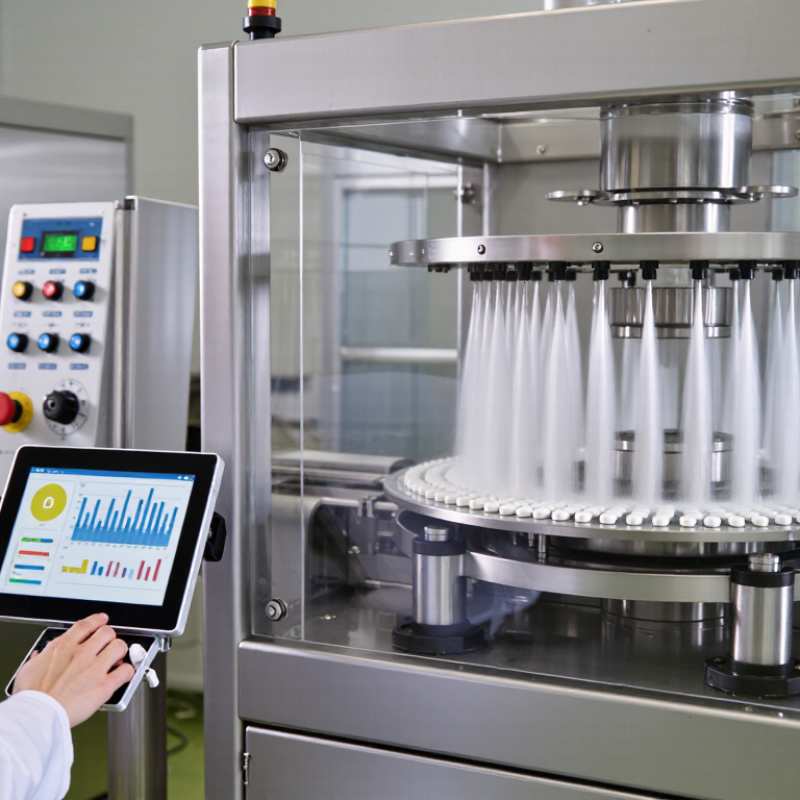
A film coating machine applies a thin, even layer to the surface of tablets or other suitable solid products. Inside, a rotating pan or perforated drum keeps the pieces moving as spray nozzles apply a coating liquid. Warm, filtered air helps the liquid evaporate, leaving a dry film behind. The process is controlled, but not automatic in every meaningful sense.
Operators adjust settings such as pan speed, spray rate, airflow, and inlet temperature. These variables affect how evenly the coating forms and how quickly it dries. For example, if liquid reaches the surface faster than air can dry it, tablets may stick together. Too much heat can create different problems, including uneven appearance. Small changes matter.
A well-run cycle depends on the product and coating formulation, so one setting rarely suits every batch. Operators monitor the equipment and inspect samples during production, rather than relying on machine readings alone. That judgment takes practice. A coating machine can improve consistency, but it cannot compensate for poor preparation or careless process control. There is room for error, and that is worth remembering.
Why Use a Film Coating Machine? What It Is and How It Works
A film coating machine applies a thin, even layer to tablets or other solid dosage forms. As the batch tumbles, a spray system applies the coating solution and heated air helps it dry. The chart shows the typical workflow order; spraying and drying can occur simultaneously.
Benefits of Using a Film Coating Machine
A film coating machine applies a thin layer to tablets or other solid products in a rotating pan or perforated drum. Warm air moves across the batch while spray nozzles distribute the coating liquid. When airflow, spray rate, and pan speed are properly balanced, the layer can dry more evenly. That matters.
A consistent film can improve appearance, make tablets easier to handle, and help protect them from moisture or abrasion, depending on the formulation. It may also support clear product identification through color. In a production run, operators can monitor inlet temperature, exhaust conditions, and spray patterns, then adjust settings when tablets look tacky or show uneven color. Small gains matter. Still, the machine cannot fix a poorly prepared coating liquid.
Automation can reduce repetitive manual work and make process records easier to compare between batches. But setup takes judgment. Nozzle distance, airflow, and batch size all affect the result, so a setting that works for one product may not suit another. Cleaning and maintenance also need attention; residue around a nozzle can disrupt spraying. A film coating machine offers better process control, not a shortcut around careful observation.
Why Use a Film Coating Machine? — Benefits of Using a Film Coating Machine | Benefit | How the Machine Helps | Practical Value | Key Consideration |
| More consistent coating | Controlled spraying and mixing help distribute coating solution across tablet surfaces. | Can improve consistency in color, appearance, and coating coverage across a batch. | Consistency depends on suitable spray rate, pan speed, airflow, and product loading. |
| Improved product protection | A film layer can help protect a tablet from moisture, light, or handling, depending on the coating formulation. | May support product stability and reduce surface damage during handling and packaging. | The coating must be compatible with the product and its intended storage conditions. |
| Taste and odor masking | A suitable coating can separate the tablet surface from the mouth and help mask unpleasant tastes or odors. | Can make some oral solid dosage forms more acceptable to patients. | Masking performance varies by formulation and does not replace taste testing or product evaluation. |
| Support for modified release | Purpose-designed coating systems can control how quickly a tablet releases its contents. | Can be used in products designed for delayed or extended release. | Release behavior requires formulation development and testing; the machine alone does not determine it. |
| Reduced manual handling | Automated or controlled spraying reduces the need to apply coating by hand. | Can improve repeatability and help limit direct operator contact with product and process materials. | Operators still need appropriate training, cleaning procedures, and safety controls. |
| Adjustable process conditions | Many machines allow adjustment of parameters such as pan speed, spray rate, and inlet-air conditions. | Helps manufacturers develop and repeat a process suited to a particular product and batch size. | Parameters should be established through process trials and monitored during production. |
Common Applications Across Industries
Film coating machines serve very different production lines. In pharmaceuticals, perforated pans or fluid-bed systems apply thin layers to tablets. These layers can mask bitter tastes, improve swallowing, or control moisture exposure. Operators watch spray rate, inlet temperature, and tablet movement; small changes can leave uneven color or tacky surfaces. Small details matter. IQVIA Institute’s 2024 report projects global medicine spending will reach $2.3 trillion by 2028. That figure reflects demand for medicines, not coating-machine sales, but it helps explain the need for consistent, scalable production.
Food manufacturers use coating equipment for chocolate pieces, nuts, cereal clusters, and confectionery. A rotating drum tumbles the product while fine sprays or powders build an even outer layer. FAO’s 2023 statistical yearbook reports that 13.2% of food was lost between harvest and retail in 2021. That broad figure is not evidence that coating prevents food loss; product type, packaging, and storage conditions also matter. In agriculture, machines coat seeds and fertilizer granules to improve handling or apply measured surface treatments. Yet one setting rarely suits every material. A fragile seed, sticky nut, and fast-moving tablet behave differently, so trials should check coating uniformity, dust, and product damage before full-scale runs.
Factors to Consider When Choosing a Machine
Choosing a film-coating machine starts with the product and batch size, not the biggest drum. Check whether the pan can handle both routine loads and smaller development batches. Then examine airflow, spray-rate control, and exhaust performance. These affect drying, coating uniformity, and the risk of overwetting. Small details matter. Ask how operators monitor product temperature and spray distribution, and whether readings can be recorded for each batch. FDA’s 2011 Process Validation guidance emphasizes qualified equipment and documented process control. A rated capacity alone does not demonstrate consistent performance.
Cleaning access, changeover time, and maintenance should also shape the decision. Look for reachable spray nozzles, inspectable filters, and clear procedures for cleaning the pan and ducts. FDA’s 2019 Drug Shortages Task Force report found that 62% of drugs entering shortage from 2013 to 2017 were associated with quality problems. That finding does not implicate coating machines, but it underlines the value of dependable, controlled production. Compare machines using trial batches and measurable criteria, such as coating-weight variation and drying time. A neat specification sheet can still hide awkward cleaning or uneven spray coverage. I would treat vendor estimates cautiously until the machine has been tested with the actual formulation.